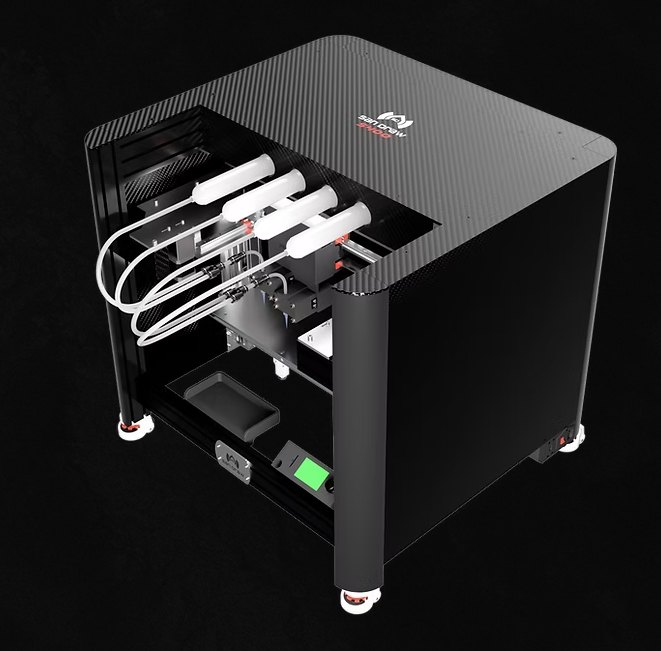
Lesson 3.1: Overview of Silicone 3D Printing
🎯 Learning Objectives
By the end of this lesson, learners will be able to:
-
Identify the main types of silicone materials used in additive manufacturing.
-
Describe the key physical and chemical properties of silicone relevant to 3D printing.
-
Understand why silicone is chosen for specific functional and biomedical applications.
🌟 Overview
Silicone 3D printing represents a rapidly growing area in additive manufacturing due to silicone’s unique combination of flexibility, biocompatibility, and thermal stability. Unlike traditional thermoplastics or rigid resins, silicones enable the fabrication of soft, elastic, and durable parts suitable for various industrial, medical, and wearable applications. This lesson provides a foundational understanding of the materials and properties involved in silicone-based 3D printing technologies.
🧪 Types of Silicone Materials Used in 3D Printing
Silicone materials used in 3D printing vary in curing methods and formulations, each tailored to specific applications and printer types. Below are the main categories:
-
🧊 Room Temperature Vulcanizing (RTV) Silicones
Cure at ambient conditions without the need for heat. Commonly used in extrusion-based systems, these silicones offer ease of handling and are ideal for prototyping and low-temperature applications. -
🔥 Heat-Curable Silicones
Require elevated temperatures (typically 100–200°C) to crosslink and solidify. These are preferred for parts needing enhanced mechanical strength, chemical resistance, and thermal stability. -
💡 UV-Curable Silicones
Solidify under ultraviolet light exposure and are compatible with DLP or SLA printing technologies. They allow for high-resolution prints and are useful in microfluidics or optical applications. -
⚗️ Two-Part Silicones
Consist of a silicone base and a curing agent mixed immediately before printing. The crosslinking reaction starts during extrusion, offering excellent control over viscosity, print time, and curing behavior.
🧩 Key Properties of Silicone for Functional Parts
Silicone’s distinctive properties make it ideal for 3D printing in applications where flexibility, durability, or biocompatibility is required:
-
Elasticity and Flexibility:
Silicones can stretch and return to their original shape without permanent deformation, making them suitable for seals, gaskets, and soft robotics. -
Biocompatibility:
Many silicones meet ISO 10993 and USP Class VI standards, allowing them to be used in medical devices, implants, and prosthetics. -
Thermal Stability:
Silicones can withstand extreme temperatures ranging from -50°C to over 200°C, making them useful in aerospace and automotive applications. -
Chemical Resistance:
Resistant to water, oxidation, and many chemicals, which extends their functional lifespan in harsh environments. -
Transparency and Customization:
Silicones can be pigmented or remain optically clear, and their mechanical properties can be tuned by altering formulations.